Most villa CCTV in Bali is installed backwards: cameras pointed at pretty views instead of entry points, footage streaming to a cloud subscription that dies with the internet, and no thought given to who is allowed to be on camera. After hundreds of security installs from Canggu to Uluwatu, this is the guide we wish every owner read before buying a single camera — where cameras belong, how footage should be recorded in a place where the internet drops weekly, and what the privacy rules mean for a villa with staff and paying guests.
Where Cameras Belong on a Villa Plot
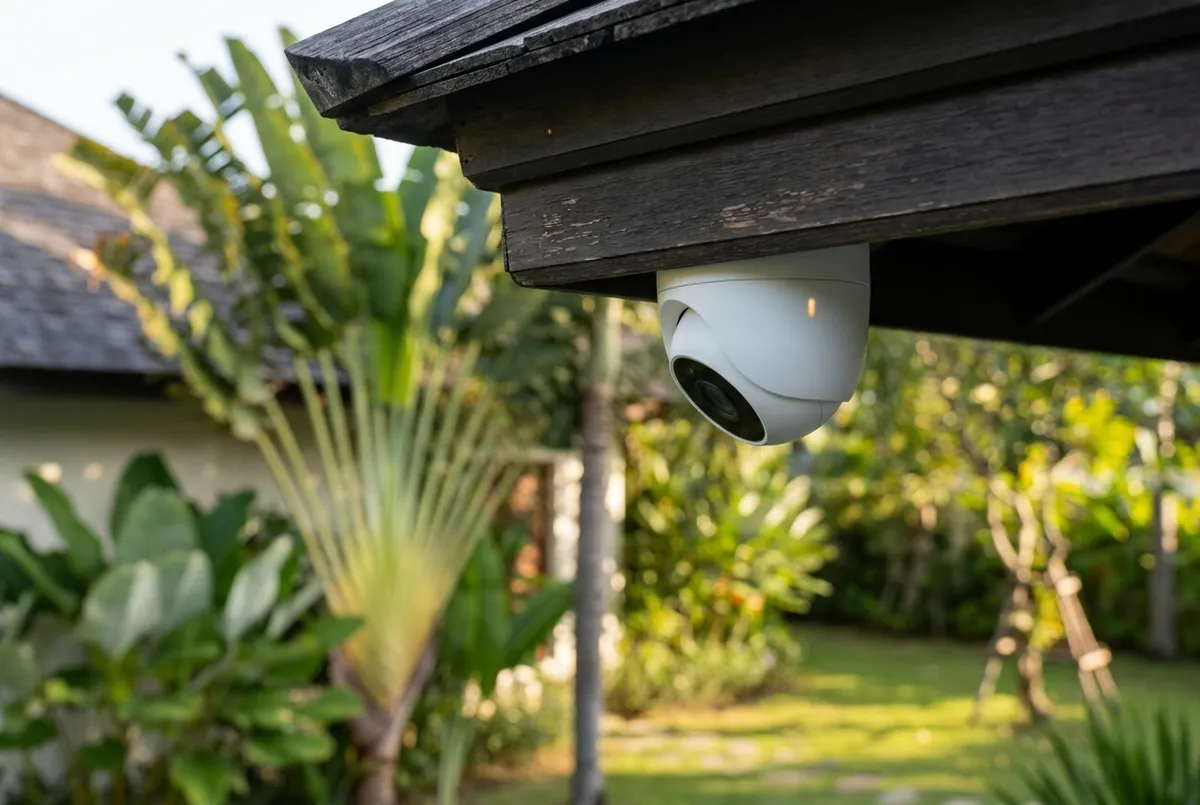
A villa needs fewer cameras than most owners expect — but they must be in the right places. The pattern that covers 90% of incidents uses four to six cameras:
The gate and driveway. Every person and bike that enters the plot passes here. One camera facing the approach and one facing back at the gate itself catches faces both ways — the single most valuable footage you can own.
Entry doors, not bedrooms. The main door, the staff entrance and any ground-floor sliding doors that face the garden. Interior cameras stop at shared spaces; they never belong in bedrooms or bathrooms, and in a rental villa we keep them out of indoor guest areas entirely.
The blind side. Almost every Bali plot has one — the service corridor behind the kitchen, the wall shared with an empty plot, the beach path behind the pool fence. Walk the perimeter at night and you will find it in five minutes; so will anyone else.
Mounting matters as much as position in the tropics. Cameras go under roof overhangs where rain and direct sun cannot reach the lens, high enough to be out of casual reach but low enough that faces — not just the tops of heads — fill the frame. Within a kilometre of the coast we specify housings and mounts that tolerate salt air, because standard powder-coated brackets start shedding rust streaks down white walls within a year.
NVR vs Cloud: Record Locally in Bali
This is the decision that separates a security system from a subscription. Cloud cameras upload footage to someone else's server — which works until the fibre goes down, and in Bali the fibre goes down. A cloud-only camera during an internet outage is a plastic box. Worse, the outage-shaped hole in your footage coincides exactly with when you most want coverage, because power and internet cuts are when opportunistic theft happens.
We record to a local NVR (network video recorder) — a small box in the network cabinet holding two to four weeks of continuous footage from every camera. It keeps recording through internet drops and, on a small UPS, through PLN blackouts as well. There are no monthly fees and footage stays in the villa, which also simplifies the privacy picture below. Remote viewing still works exactly as owners expect: open the app from Singapore or Sydney and watch live or scrub back through the timeline — the internet is needed only for the viewing, not the recording.
Cloud backup still has a place for one or two critical cameras — if a burglar takes the NVR itself, an off-site copy of the gate camera is worth having. We add it selectively rather than paying to stream eight cameras to a data centre around the clock.
Hardware That Survives the Tropics
We install Ubiquiti UniFi cameras on almost every project: PoE-powered (one cable for data and power, no plug sockets in the eaves), locally recorded, no subscription, and the housings genuinely tolerate humidity. Budget Tuya cameras have their place for a single self-monitored spot inside a rented villa, but as the backbone of a villa system the difference in reliability is not close.
Two specification rules save most of the disappointment we get called to fix. First, PoE over WiFi wherever the cable can physically run — WiFi cameras drop off the network exactly when you need them, and their plug-pack power supplies corrode in outdoor boxes. Second, night performance is about infrared reach and sensor size, not megapixels; a camera that claims 4K but sees ten metres in the dark is the wrong camera for a fifteen-metre driveway.
Privacy: Staff, Guests and Indonesian Law
Indonesia has a general data-protection law (the PDP Law, in force since 2022), and camera footage of identifiable people is personal data under it. This is not legal advice, but the practical rules we follow on every install keep owners out of trouble:
Tell your staff. Cameras covering staff working areas should be no secret — a written line in the work agreement and visible camera positions. Hidden cameras pointed at staff are how villa-management horror stories start.
Guests: outdoor and entry points only. In a rental villa, cameras belong at the gate, the parking area and external entrances — and must be disclosed in the listing (Airbnb and Booking.com both require it and ban indoor cameras entirely). Nothing indoors, nothing facing the pool where guests swim, no audio recording.
Keep footage tight. Two to four weeks of retention, overwritten automatically, viewable by the owner and villa manager only. A small "CCTV in operation" sign at the gate costs IDR 50,000 and removes any argument about whether recording was disclosed.
What Villa CCTV Costs
A four-camera UniFi system with an NVR, PoE cabling and app setup starts from IDR 6,500,000 installed — the same package our smart security service quotes, and it integrates with door sensors and smart locks on the same hub. A larger plot with six to eight cameras, a dedicated switch and UPS backup typically lands between IDR 12 and 20 million. Cameras alone without installation are cheaper, of course — but placement, cabling and recording setup are precisely the parts that determine whether the footage is usable the one time it matters.